- Trishan's Newsletter
- Posts
- 3 Silent Killers of Your Intelligence (And How To Reverse Them)
3 Silent Killers of Your Intelligence (And How To Reverse Them)

Trishan Lekhi
August 03, 2025
Are We Getting Dumber?
Let’s be honest for a moment. When was the last time you felt truly, deeply focused?
I don’t mean the frantic, multi-tab focus of a busy workday. I mean that quiet, settled, all-in concentration where the world outside your task simply melts away. The kind of focus that lets you untangle a complex problem, lose yourself in a book for hours, or have a conversation so engaging you forget to check your phone.
If it feels like a distant memory, you’re not alone. We’re living in an age of supposed cognitive enhancement, with information at our fingertips and tools to make us smarter, faster, and more productive. And yet, a nagging feeling persists, backed by a growing mountain of evidence, that we are in the midst of a quiet crisis. A crisis of the mind.
Consider the data. In the last two decades, our collective attention span has plummeted. One Microsoft study famously clocked the average human attention span as being shorter than that of a goldfish (eight seconds for us, nine for our gilled friends. Ouch). Vocabulary is shrinking, too. The working vocabulary of an average 14-year-old has fallen from around 25,000 words in the 1950s to just 10,000 today.
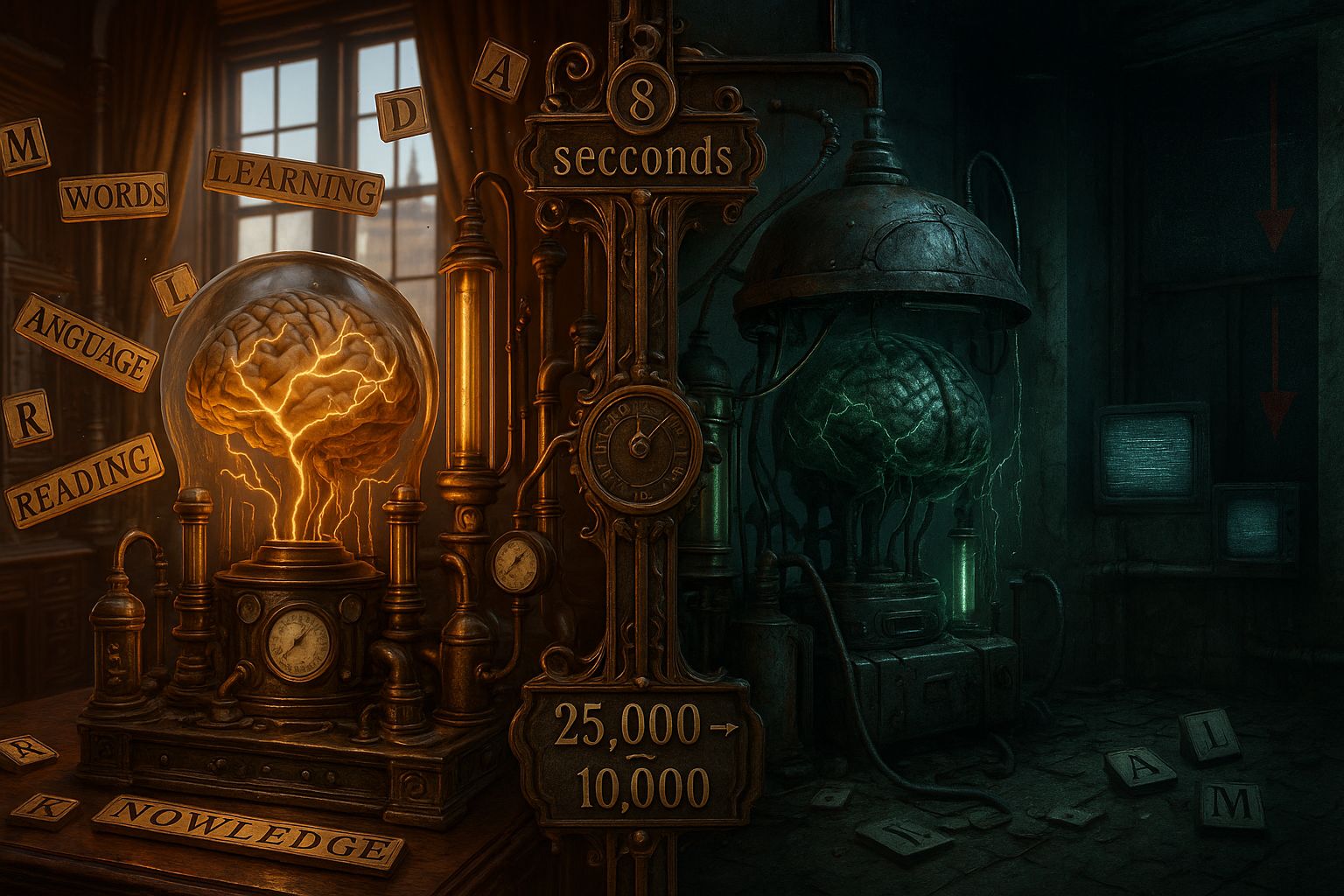
Most concerning is the reversal of a century-long trend. The Flynn Effect, discovered by scientist James Flynn, observed that our collective IQ rose consistently by about three points per decade since the early 20th century. But for the first time in a hundred years, that trend has not only stopped—it has reversed. We are now seeing a minus reading in IQ charts.
So, what’s happening? Why does it feel like our brains are running on dial-up in a 5G world?
This isn’t about a single villain. It’s a systemic problem, a perfect storm of three powerful forces working in concert to dull our collective edge: The Digital Deluge, The Nutritional Deficit, and The Wisdom Gap.
Part 1: The Digital Deluge (The Attention Economy’s True Cost)
In his book The Dumbest Generation, author Mark Bauerlein argues that today’s youth are struggling to bear even basic cognitive loads—finishing a book, sustaining a deep conversation, or wrestling with a complex thought. They are natives of a digital culture that prizes speed and stimulus over depth and contemplation.
Before a child can even properly think, we hand them an iPad.
We’ve all seen it: the toddler, eyes glazed, completely mesmerized by the screen. Shows like Cocomelon are masterpieces of cognitive capture. With scene changes every one to two seconds, they are engineered to be so hyper-stimulating that a child’s brain doesn’t have a moment to get distracted. The bright colors, the repetitive sounds—it’s a constant drip-feed of dopamine that makes the real, slower-paced world seem boring by comparison.
The result is a brain wired for constant distraction. When the screen is on, the child is placid. When you turn it off, they erupt. We’ve seen the viral videos: the child having a meltdown on an 8-hour flight because the iPad is gone, or the 15-year-old who, as a recent news story reported, destroyed the family home in revenge after his mother took away his device.
This isn’t just a problem for kids. It’s a problem for us all.
A landmark study from the University of Texas at Austin found that the mere presence of your smartphone—even if it’s turned off, face down on the table—significantly reduces your available cognitive capacity. A part of your brain, whether you’re conscious of it or not, is actively working to not pick up the phone. That little bit of background processing power is constantly wondering: Did I get a notification? Who messaged me? What’s happening online?
You are, in effect, outsourcing a piece of your intelligence just by having the device nearby. In this way, the tools promising to make us smarter are, ironically, creating a persistent state of brain fog. We’re swimming in an ocean of information, but our minds are too distracted to drink any of it in.
Part 2: The Nutritional Deficit (Starving the Modern Brain)
Our cognitive decline isn’t just happening from the outside in; it’s also happening from the inside out. Our modern diet is systematically starving our brains of the essential nutrients required for peak function.
For millennia, human brain development was supported by specific nutrients, chief among them DHA, an omega-3 fatty acid. It’s a primary structural component of the human brain. Historically, women’s bodies stored these crucial fats (particularly around the hips and thighs) to build the brains of their children during pregnancy and breastfeeding. A mother with ample reserves of these "smart fats" was biologically equipped to grow a child with a robust, well-developed brain.
But as Western beauty standards shifted to prize extreme thinness, and our diets became dominated by processed foods lacking in these essential fatty acids, we created a nutritional deficit. A mother who is herself depleted of these critical nutrients simply doesn’t have the reserves to pass on, potentially compromising the cognitive foundation of the next generation.
This is compounded by our love affair with carbohydrates and sugar. A typical modern meal is carb-heavy, leading to a constant spike in blood glucose. To manage this, our pancreas pumps out insulin. When insulin levels are chronically high, it can interfere with glucose transport to the brain, effectively starving our brain cells of their primary fuel. Neurons can’t communicate properly, and we’re left with that familiar feeling of mental slowness and brain fog.
And then there are the microplastics.
They are everywhere: in our water bottles, our food containers, our polyester "dry-fit" clothing. When we microwave food in plastic or drink from a plastic bottle, these microscopic particles enter our bodies. The terrifying fact about microplastics is that our body has no natural mechanism to excrete them. They accumulate over time, lodging themselves in our organs—and, as research now suggests, potentially crossing the blood-brain barrier. While the full impact is still being studied, the idea of plastic accumulating in the brain is a chilling one.
Part 3: The Wisdom Gap (Data vs. Discernment)
The final piece of this puzzle lies in our education system and our relationship with knowledge itself. Professor Bauerlein points out a troubling trend: young people often dismiss historical knowledge, thinking, “Why bother learning anything when I can just Google it?”
On one level, it makes sense. Why memorize dates and facts when all of human knowledge is in your pocket? But this creates a dangerous illusion—the feeling of being knowledgeable without having done the work of actually knowing.
A person who outsources their memory to a search engine also risks outsourcing their judgment. Instead of building their own values and moral framework through deep engagement with history, philosophy, and culture, they become highly programmable. Their worldview is shaped not by wisdom, but by the top search result.
Philosophers call this the problem of Data vs. Discernment. We have access to infinite data, but we are developing finite discernment—the wisdom to know which information is right, which is wrong, and most importantly, which is meaningful.
Our schools often fail us here. History is taught as a boring timeline of names and dates to be memorized for a test. Rarely does a teacher explain why it matters—that by understanding the patterns of history, we can understand the patterns of humanity. We learn to see the mistakes our ancestors made and, hopefully, avoid repeating them.
When we lose that connection, we start to see the vast library of human culture not as living wisdom, but as dead information. We become people who know the price of everything and the value of nothing.
The Antidote: How to Reclaim Your Mind
Reading this, it’s easy to feel a sense of despair. But awareness is the first step toward a solution. If this problem bothers you, it’s a good thing. It means you are one of the few who are tired of being average, who refuse to passively accept a duller mind.
Reclaiming your cognitive power doesn’t require a complete life overhaul. It begins with three conscious shifts:
Eat for Your Brain. Go back to basics. Eat the kinds of whole, unprocessed foods your ancestors thrived on for millennia—a balanced diet of quality proteins, healthy fats (rich in omega-3s), and complex carbohydrates from vegetables and whole grains. Drastically reduce your use of plastics in the kitchen. Your brain is built from the food you eat; give it premium materials.
Practice Deep Work. You must intentionally carve out time for focused, single-tasked concentration. Start with a simple "2-Hour Rule": spend the first two hours of your day without your phone. Use that time to read a physical book, write, tackle your most important project, or exercise. You are training your brain to derive fulfillment from effort, not just from cheap digital rewards. This is how you rewire your dopamine circuits to serve you, not the algorithms.
Pursue True Knowledge. Don’t just consume information; cultivate wisdom. Pick one subject—any subject you love, be it cars, psychology, ancient history, or photography—and go all in. Read the foundational books. Understand its history and cultural context. Become a true expert in something. This act of building a deep, internal well of knowledge protects you from being programmed by the shallow currents of the internet. It makes you unique. It makes you powerful.
The Choice Is Yours
Most people who encounter this information will feel a brief flicker of alarm, then go right back to their old habits. They will continue scrolling, continue eating poorly, and continue to let their most valuable asset—their mind—slowly erode.
But you don’t have to be one of them.
This isn't just about reclaiming focus; it's about reclaiming your life's work. Think of the great cathedrals of Europe. They were built over generations by artisans who dedicated their entire lives to a single, magnificent purpose. Each stone was laid with intention, each window crafted with mastery. They didn't have notifications to distract them; they had a legacy to build.

In our own lives, we are all builders. The question is, what are we constructing? Are we building a cathedral—a life of depth, meaning, and lasting value—or are we endlessly rearranging the digital sandcastles that the tide will wash away tomorrow?
The path to a sharper mind is the path to a more meaningful existence. It’s a quiet rebellion against the noise of the modern world. It is the choice, made every single day, to lay another stone in the foundation of your own cathedral.
What will you choose to build?